From a Race Dad

The sky was so blue,

The sun so bright!

The trees stood so green,

And clouds their wispy white.

That day! The sun crisped colors

In just the way that makes artists crave New Mexico—

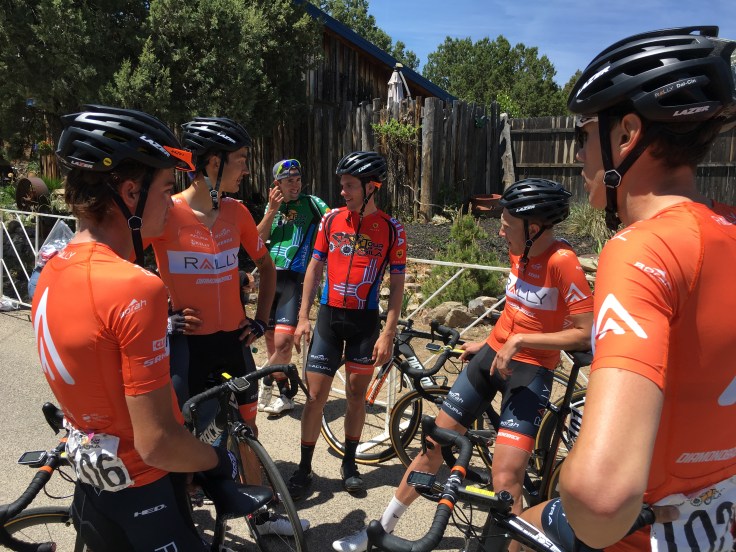
And magnified the kits to max the greens

And oranges and blues, helmets sheening,

And girls radiant in their hair.

At Pinos Altos race news was rare,

So no leaders, gaps, names.

Just pure racing that day, and pure waiting,

Ironic in that place that communicates

Most easily into the mysteries,

That very large array of riders,

Coursing under that sky

Whose every night brings

The stars within reach.

I even thought of ee cummings,

His leaping greenly spirits of trees.

And all we could see—

The sky so blue,

The sun so bright!

image

The armadillo drive

On Sunday the Tour of the Gila finished in Pinos Altos, NM, a few miles from Silver City on the continental divide. The Rally pro cycling team was feeling celebratory. They rode downhill back into Silver City for postrace milkshakes at Sonic. It’s a tradition for the winner to treat his team before everybody packs up and heads to airports. Pro cycling teams don’t live or train together and usually only see each other at races.

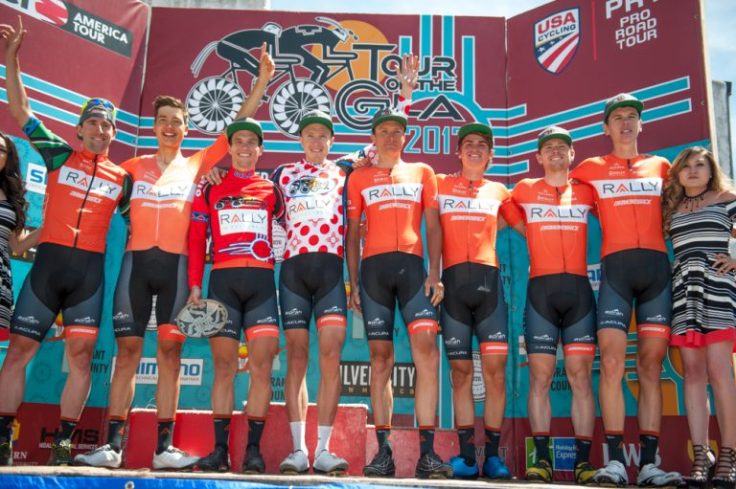
My view of the podium in front of the Buckhorn in Pinos Altos, NM: Team Rally from left: Eric in orange vest, Adam DeVos, Evan Huffman in red race-leader jersey, Rob Britton in polka-dot King of the Mountain jersey, Danny Pate, Sepp Kuss, Colin Joyce, Mateo Dal Cin. Best Overall Team

imageimage

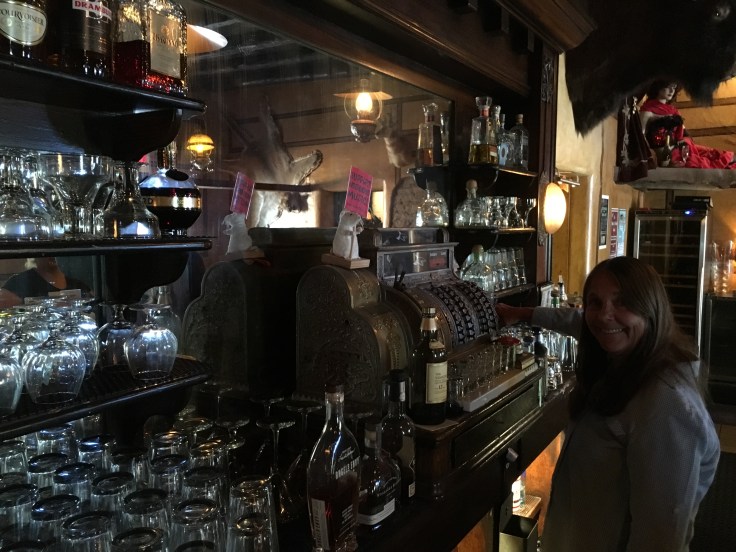
Inside the Buckhorn Saloon

The terrible thing about the immediate post-race time was that everyone knew that a cyclist from team Axeon Hagens Berman had been badly injured in a crash. He was already evacuated to hospital by helicopter, but there was no news. It’s not unusual for cyclists to crash, and they wear no protective gear except a helmet. Dressing in skintight lycra to avoid wind drag doesn’t help.

Usually there will be a Tweet from hospital with a brave and droll comment from the injured that he has a broken collarbone (the most common cycling injury), or some other shorthand for pain and recovery that other cyclists all understand. No one had anything yet. The Axeon (pronounced “action”) team is a developmental team in the pro ranks, so all the riders are young, generally 23 and under. This rider is 21. Age 21 with no news became two bad things. The third bad thing was that he’d been described as “airlifted with facial injuries,” which meant he’d hit his head. The road where the crash occurred is steeply downhill and he’d been trying to “chase back on,” cycling shorthand for “Oh my God, I’ve got to catch up!” Chasing back to the peloton’s relentless pace in the final stretches of a pro race can be an impossible task, and if you can’t do it quickly chances are you can’t do it at all. My mind at times like this goes to my own son. There’s nothing I can do about that, and it didn’t help that the injured happened to have our same last name. Yeah, so there was that.

We popped down to Silver City ourselves, said good-byes, stopped at an artist store we’d admired, and hit the road. It was still early afternoon, and we had the intent to get into Texas, not so much for love of Texas as to lose the timezone hour. Amarillo would mean eight hours done. First, back to Albaquerqee (still can’t spell it!) by a different route, a beautiful mountain road through Gila National Forest that Tour of the Gila had used as a race route. We hadn’t driven it yet, because we’d arrived last Wednesday by heading straight to the day’s finish line. The road was a gorgeous twisting mountain drive with plenty of S-curve advisory signs down to 15 mph and even 10 mph. Pro cyclists during a race routinely take these at double or even triple the posted limits. A little sand or a small bump can be a problem. We stopped briefly at turnouts, got out of the car, and admired the views. New Mexico: Land of Enchantment. And copper mining. And road runners and lizards and tumbleweed.

Armadillos too? No, those were the next day. In Missouri we had a contest going to see who could spot roadkill armadillos first. We saw a combined fifteen dead armadillos! Sure there were the occasional raccoon or possum as well, but those armadillos! Armored, but not enough to cross a highway.

**Note: one correction, I found out later that Chad Young whom I described as trying to “chase back on” was, in fact, bridging up to the lead group in the race– same effect on the frantic nature of the effort required, but a world of difference in what it means to cyclists. I regret that error

All the world’s a Stage . . .

The world of bicycle racing is a pretty strange world, and one of the strangest places is southern New Mexico: The final stage of 161.9 km (100.6 miles) and total elevation gain of 9,131 ft (2,783 m), known as The Gila Monster, finished on the continental divide at Pinos Altos, NM, (over 7,000 ft. above sea level), the main feature of which is a restaurant-bar and honky-tonk, The Buckhorn Saloon, a former brothel and proud of it.

image

Rally Cycling, after winning Tour of the Gila 2017. Evan Huffman, center in red leader jersey, was the overall winner over five days of racing. Two not pictured.

But maybe the strangest thing about a pro cycling race is that it’s a team event that a team can’t win. Instead, an individual racer pulls out victory. At Tour of the Gila, considered one of the most grueling races in the world, Evan Huffman figured out a way to do that, but he could not have done so without his team pictured above. From left, Sepp Kuss, Adam DeVos, Eric (in green sprinter leader’s jersey), Evan (overall winner), Rob Britton (who ended the day as best climber jersey, known as King of the Montain), and Mateo Del Cin (Stage One winner) were six of the keys to victory, but Danny Pate who serves as their road general, and Colin Joyce, third place on Stage One that began the weekend, were still coming in.

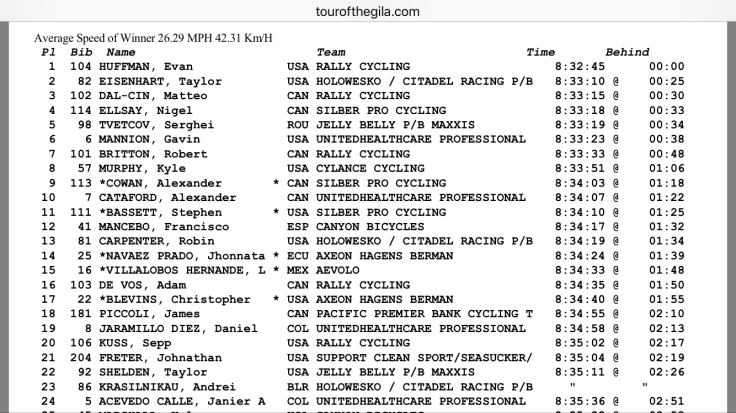
This table shows the rider standings before the final stage of racing:

image

In this table, far right shows the amount of time a rider had to make up to put himself into the overall lead. On the last day Evan Huffman had 25 seconds on Eisenhart, 33 seconds on Ellsay, 34 seconds on Tvetcov and 38 seconds on Mannion. (The two other riders within one minute of Evan were teammates Dal Cin and Britton.) The rider in 14th place Naveaz won the day’s race but not by a large enough margin to make any difference in the overall five-day race, because he’d started the day down 1:39.

At the day’s podium presentations, after all the real prizes had been announced Rally Cycling, the whole team, took to the platform as the fastest overall team.

image

You’re gonna need a bigger vase

imageimageThe flowers. Yeah, not sure why, but bicycle racers get flowers when they win.

image

Stage 4 flowers: Tour of the Gila

Late afternoon: I watched Stage 4 from a coffee shop porch, because it was one story up and the view was excellent all the way to the finish banner on the main street of  downtown Silver City, NM — a fast circuit of laps, each a bit more than a mile. The 40 laps took the racers 1:30:19 to complete, an average speed of 28.9 mph. They drank bottles of water, but I drank iced tea and chatted with other fans enjoying the same vantage point. Two businessmen from California who’d participated in an amateur race earlier in the day, several family members of an 18-year-old new pro in his first big stage race, and some others, everyone happy to be there on a day at altitude with bright sun and gentle winds. On a full crit docket the Pro men race last, so this had been going on since 8 am. My day started about 6 when I threw on shoes and hustled from our hotel to move my car off of the closed street.

As the pro race developed it looked like Eric would have a decent chance to take the final sprint. Attacks off of the front by racers taking a chance to build a short lead into the wind had all come to nothing, and with two laps to go the field of cyclists was all together, one swarm strung out about a block long and traveling close to 30 mph. They whirred out of sight, and we waited the minutes for the lap to complete. Next time would be one to go, and when the lead group banked around the final corner and into view it consisted of a straight-out train of four Cylance teammates in blue, and Eric in Rally orange tucked in behind looking comfortable. I knew that’s good. One to go. Then they were gone again.

Crowd noise increased, the race announcer told one more story that I didn’t hear, then came the motorcycles accelerating out of the way, then suddenly orange at the front, out of the saddle, Eric pumping hard with his bike rocking and Travis McCabe near his wheel, but getting dropped. The line of pro racers strung out behind that, but nobody caught up. I couldn’t see the actual line on the pavement, but I could see Eric’s right arm suddenly thrust skyward and someone asked me if that was him, and I screamed Yes!

Two sprint victories in three days! Interviews and flowers still to come. His Mom got the flowers this time, their first vase a McDonald’s coffee cup, then at home, glass.

When you can only see one thing

image

Compared to Wednesday’s race the second stage of Tour of the Gila is much more conducive to a sprint finish, so naturally we wanted to see Stage 2 up close and personal. Cell coverage is rather spotty outside of town, so we had no info or updates at all. Nothing on Twitter, no TourTracker app, not even the race announcer at the finish line knew much.

We did know Eric would have a decent chance to contest the final sprint– it’s a race he had won twice before (2012 & 2015), and it has the type of “race profile” that fits his approach to winning. A Race Profile is a little chart that shows gains and losses in elevation, and in New Mexico it looks like a schematic of a mountain range– however, we’ve learned what to look for, and Stage 2 looks like what we like to see: all the climbing is over well before the finish and the last few miles offer a fast approach back into town so sprinters can move to the front and position themselves for speedy acceleration in the last 500 meters. That’s when things are apt to get interesting.

We found a vantage point about 100 meters upstream from the finish line where we had views both backwards to the final turn and onward to the finish. Then we waited for things to come into view. In front of a pro race there are always motorcycles, police cars, and officials. Behind the racers there are always team cars and support vehicles, (for example, the ambulance in the photo). In between are the cyclists.

As they came into view we saw orange. That is always a good thing, but other colors were swirling around in front and behind the orange. The orange was Eric, still trying to make his way to the front. His ideal position is “second wheel” which means he’s right there, but has one guy in front of him, one guy who is crushing his way through the air making a little invisible hole to hide inside of. In a classic sprint lead-out that guy is a teammate who is helping on purpose, but usually it’s an opponent who has started his all-out sprint earlier because he knows that’s his best chance to win. That guy was Travis McCabe, one of the best racers in the US. After a ride of 80 miles Travis and Eric had 100 meters left to see who would be on the top step of the race podium. They flew past our 100 m vantage point at about 35 mph with Travis ahead by a bike length and Eric trying to come around him. The last 50 meters of a sprint finish only takes about 2 seconds, but they are long seconds. I know that Eric has a full-on sprint that is faster than Travis McCabe’s, but faster enough to make up a bike length in 50 meters?

It was, and Eric had flowers to present to the most important spectator.

image.jpeg

Big honking road trip to New Mexico

WE started the drive at 6 pm. Heading toward St. Louis from the Chicago area naturally brought us onto the Route formerly known as US 66. Even though Rt. 66 has been decommissioned for more than 30 years it has a more robust following than any other road in the United States. Even Europeans come to drive it, and they like trains.

You need guidebooks or an App or both in order to figure out what the sights are, and how to reach them, and where you can still drive  . . . (pause to cue Heavenly Music) . . . ORIGINAL PAVEMENT! But we didn’t really do anything special except read through a guidebook while driving. In Dwight IL we neglected to buy Route 66 memorabilia, although I already own a t-shirt with logo. This is because I drove Route 66 in 2014, all by myself, so I had the shirt in my bag. If you drive the entire way (which: I highly recommend, but only if the idea has enough appeal in and of itself that no explanation is required, as there really is NO logical explanation why someone would want to drive across the country on a road that DOESN’T exist when most people don’t even want to drive that far on roads that DO exist), then you end up in California. Santa Monica to be exact, somewhat near the iconic Santa Monica Pier, which ironically does not provide public parking, so that when you actually get there, you’ll probably have to just keep driving around looking for parking. They say that 66 is the quintessential American road, so maybe that makes sense in some weird and twisted California way.

We spent a night in St. Louis, left again bright and early, and drove 1000 miles more the next day to Albuquerque. (Nobody likes to write much about Albaqwirky because it is so difficult to spell, so I’ll just say that we found a decent campus restaurant that is open to all hours of the night before limping to that night’s motel.)

The next day was bright and early again as we made our way to Stage 1 of the cycling road race Tour of the Gila. We headed straight for the finish which was projected around 12- 1 pm, and we made it just in time to be told that the access road was now closed to all vehicles. We would have to walk up.

Fine.

We parked and grabbed water bottles and started trudging up the same road that the cyclists would be riding up. We walked about 45 minutes almost straight up at 6,500 ft elevation, but could not afford the luxury of feeling sorry for ourselves– after all, the racers would be riding over 100 miles to get there.

Got to a vantage point to watch the peloton climbing up and then out of sight, caught sight of our son a bit back of the field and cheered him on. After a brief hug of hello, he continued riding up toward the finish, about 2 more km, and we were lucky to catch a ride back down to the car.

Welcome to New Mexico.

How does life DO this?

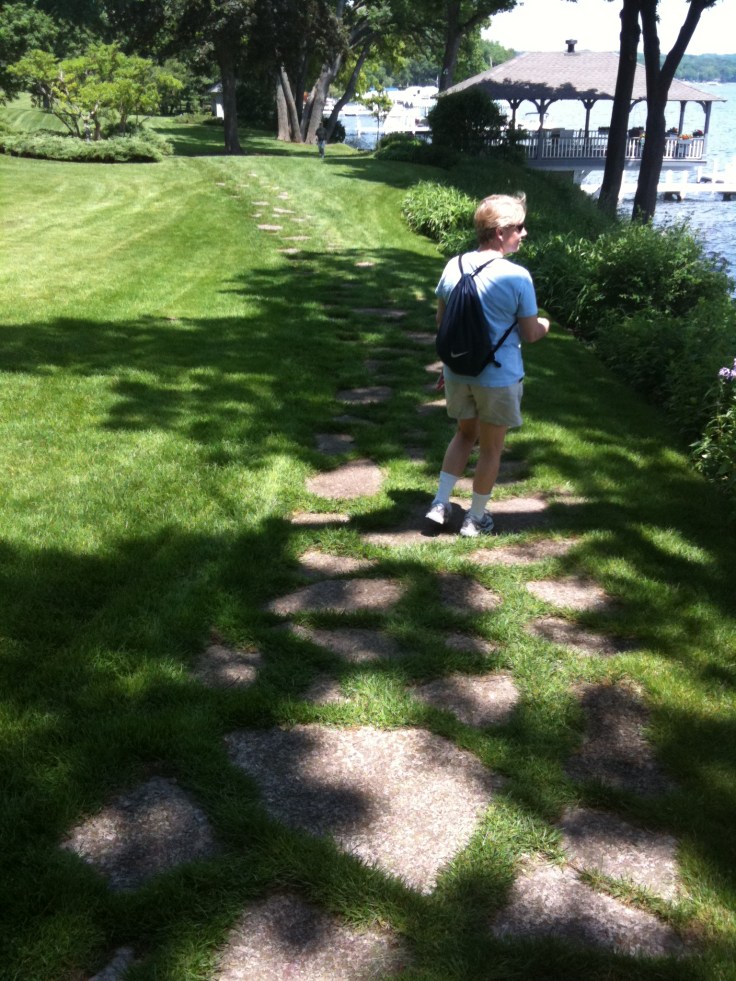
Last Sunday my spouse and I were walking together on a trail in Wisconsin when she tripped and fell. Being experienced hikers and walkers who enjoy exploring even into remote areas including backpack trails, mountain hiking and the like, of course we know that we should carry a First-Aid kit. Or at least a Band-Aid.

We had Kleenex, one of those little pocket tissue packs. When she fell she caught herself with her hands on bare rock, came down on her knees, stood up and dusted herself off and saw blood beginning to ooze. Her left hand had a nasty bit of a gash just at the base of the thumb. She sat down and collected herself, got out a tissue to cover the cut, put some pressure on it to slow the bleeding, and elevated her hand so it was higher than her heart. She didn’t really have the wind knocked out of her, but the reality of our situation started sinking in: we had a couple miles to go even to get back to our lunch stop (enjoyable burger and salad place) and no way to get off of the trail except by walking on. She asked me if I had anything with me. Like a Band-Aid? Or some Neosporin? A first-aid kit with gauze bandages and adhesive tape? Some of those little butterfly things that close a cut? ANYTHING? I had a mini-size pocket knife multitool. And a plastic cup of cold water. Oh, and she had a plastic restaurant take-out filled with leftover salad and half of a cheeseburger.

This trail– the one we like best & walk as often as we can– goes around a lake. It’s known as “the shore path,” because you are almost always in sight of the water. People like it because it is scenic and lovely and not too difficult. You hardly ever worry about a crash landing. That day we had seen a few other hikers out, but strangely it seemed Moms With Nursing Infants in Chest Carrier Day. So we were on our own. I began looking around on the ground for anything that might help us, like a piece of tape. Or string. A clean water bottle. Anything to boost the spirits would come in handy.

I saw a plastic Ziplock back on the trail maybe 8 feet from where she was seated, picked it up, and inside was a brand-new clean roll of sticky material and a sheet of instructions. It was somebody’s kit for sail repair, conveniently dropped right where we needed it. For no apparent reason but that she had a cut that needed bandaging.

We used the sticky sail stuff to create a makeshift bandage out of the Kleenex. I even cut it with the multitool knife! Sipped some water, gathered our belongings and she stood up holding her left hand in her right and keeping the hand elevated. She was able to walk the next mile & then we stopped at a summer camp place that had an open building with chairs and a bathroom accessible, so she could sit and wait. There was even a lady at the desk who offered help and real first-aid equipment. My spouse declined, because the sail repair stuff had been doing a great job of holding her thumb from falling off. So I went on, got the car, drove back and picked her up.

Then we went home and made some tea. She washed off her hand and really looked at it. We went to the Emergency Room. She got stitches. And purple elastic stuff wrapped around to keep the pressure on. It worked almost as well as sail-repair.

Here is the question: how does life DO that? Figure out what you need to move ahead and then drop it into your lap at the exact moment, and then act like nothing happened?IMG_0115

Bonfire: The best of the best of the best

Here is a compilation in video of ALL of the winners of the Academy Award for Best Cinematography, in year order. (It’s from Feb. 2017 and ends with the nominees as the winner had not yet been named.)

The scene caught in freezeframe is from La La Land (2016) with Ryan Gosling and Emma Stone. Linus Sandgren for La la Land won the award for Best Cinematography at this year’s Academy Awards.

The link below takes you to the original article on thefilmstage.com It includes a list of all the winners in chronological order:

https://thefilmstage.com/news/witness-the-evolution-of-cinematography-with-compilation-of-oscar-winners/

Blog at WordPress.com.

Up ↑